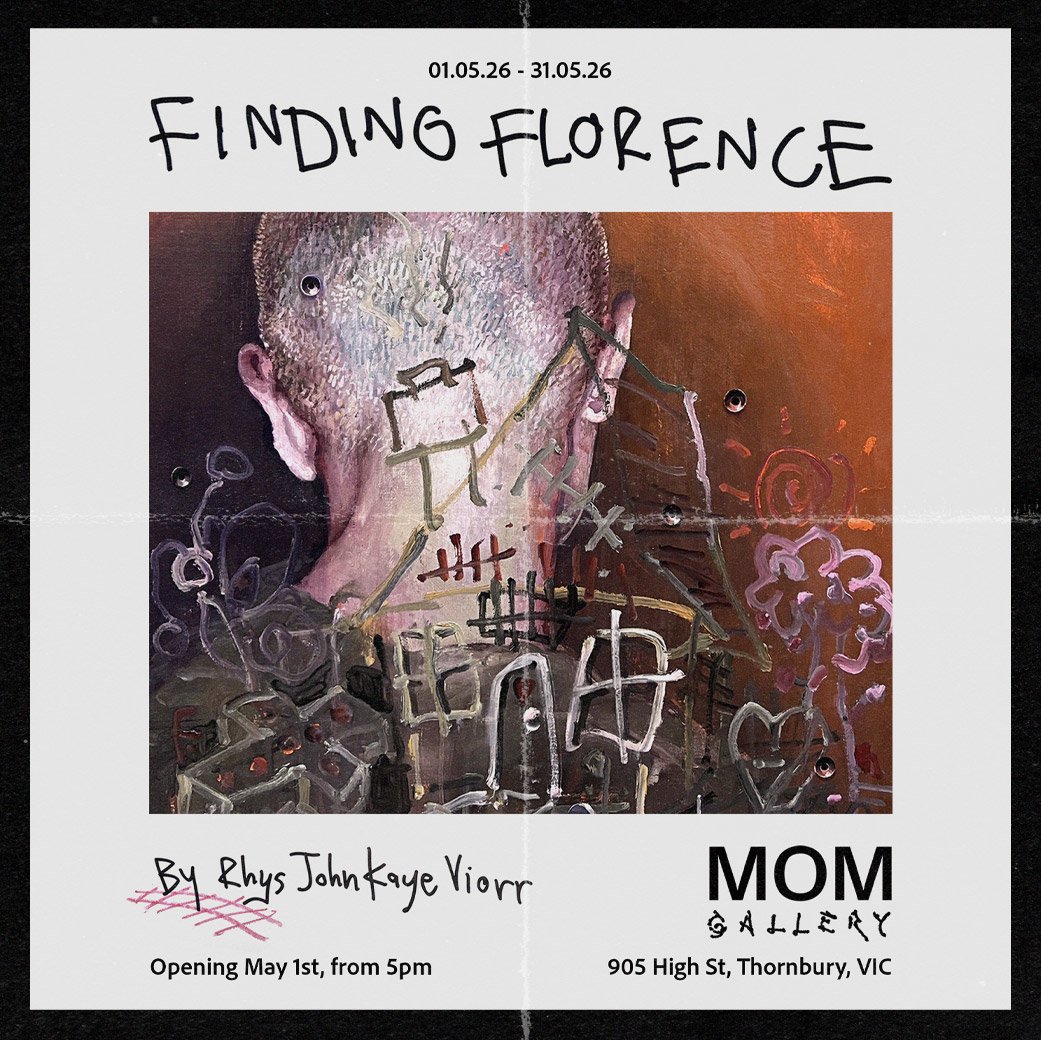
Finding Florence is concerned with a question of agency. Do we choose our own path, or is life decided for us by a force that’s free from form or name?
Can we tap into this force and work with it, or are we powerless?
The crash of a moving truck saw the most precious relics of Rhys’ family turned into a pile of wet, broken timber. These objects, which once grounded him in reality, held a proof of belonging. Without them, Rhys has had to confront what remains. What are we left with when our anchor disappears?
Memories, for a while. Expression, always.
At this time, Rhys was working with his hands every day, building a home after a period of instability. The same materials started to cross over—timber, concrete, drilled surfaces. The holes in the works speak to fragility, to how easily a surface can be altered, but also to preparation. A pilot hole makes space, it allows something to enter without splitting everything apart. What looks like damage can also be what lets the work hold.
There’s a tension between destruction and construction running through the paintings. Marks of movement cut across the surface, and layers are built up and then broken down when they feel too resolved. A heart rests cracked and wounded, still its side twists upward, as if it might rise again. Some forms drift in and out within the body of work. Familiar drill holes come into play in the collages made from ripped up journal pages, rebuilding his previous ideas of the world, preserving his prior self.
I try to find the word for the sensation you experience when you visit the ocean or the mountains. The total vastness is overwhelming and inspiring in equal measure. The focus of Rhys’ work instills that same feeling in me. The source is not physical like a mountain, it’s not place, but instead time. In the context of everything else, my choices feel inconsequential. To borrow a phrase from George Saunders, I feel like I’ve gone for “a swim in a pond in the rain.”
I am reminded how small I am by the magnitude of everything around me.
In a way, this body of work is about self-preservation after a deep shedding—taking stock of what’s left and choosing what to carry forward. It’s an instinctive response to uncertainty, a reckoning with the beauty of fragility.
Belonging isn’t fixed. It’s something Rhys keeps working at, something that shifts and flexes as he does, as the force of life asks him to.
Written by Maya Honey-Holmes